Sydney Property Supply vs Demand 2026: Key Trends Now
Will More Supply Cool Sydney Property in 2026 — Or Is Demand Still Too Strong?
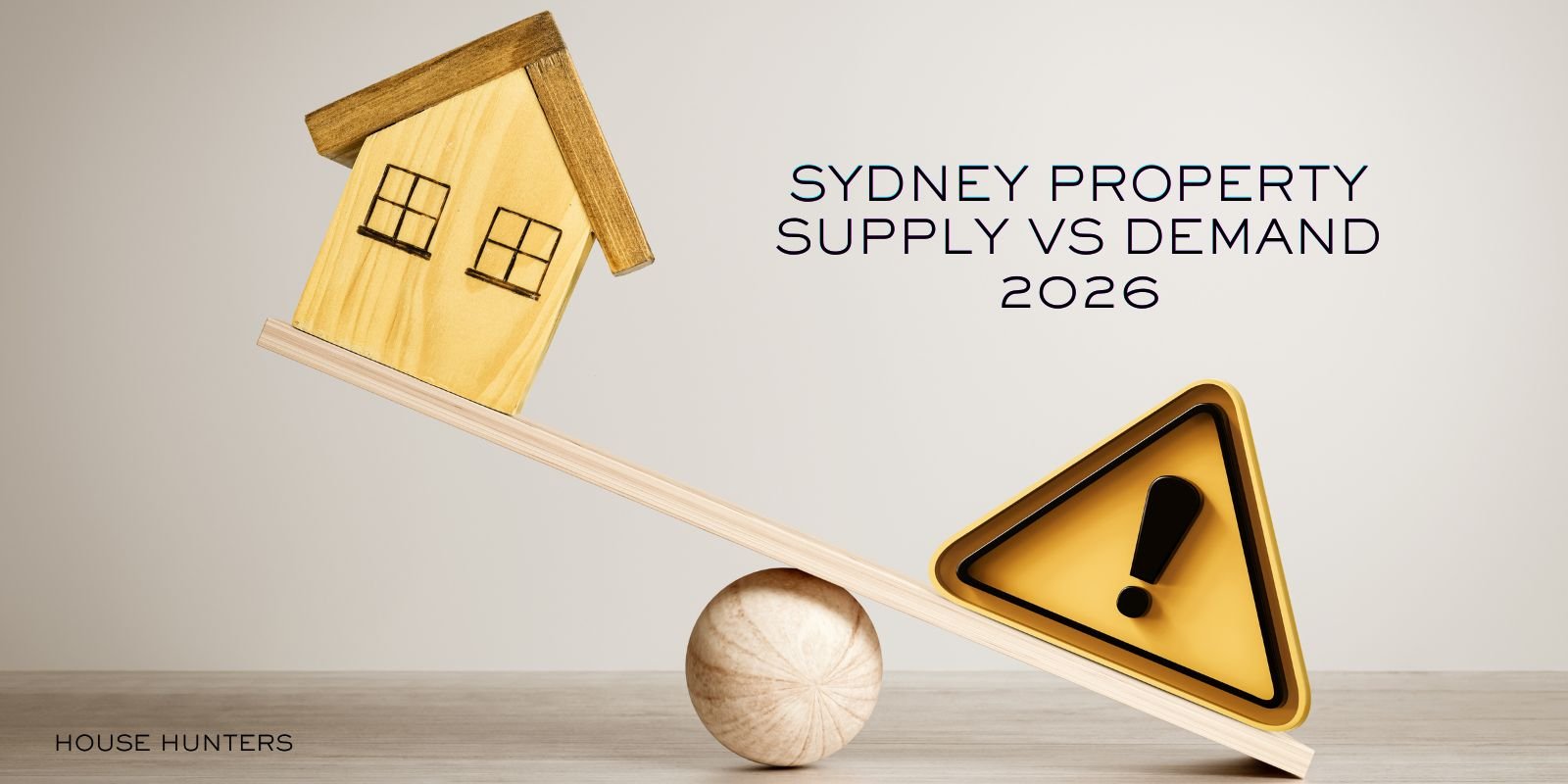
Sydney Property Supply vs Demand In 2026: Sydney’s 2026 market is not behaving the way traditional supply logic suggests. Listings have increased across multiple corridors, yet price pressure persists—especially in the $700K to $1.2M bracket where most borrowing-constrained buyers are active. The core issue is not whether supply is rising, but whether that supply is usable. Right now, much of it isn’t.
Buyers are seeing more properties online, but the proportion of listings that actually match borrowing limits, location preferences, and rental viability remains tight. This is why competition has not eased in practical terms. Supply is visible—but not functional where demand is concentrated.
In 2026, Sydney’s supply is rising in volume, but not in the segments where demand is strongest—keeping price pressure intact.
Supply Is Increasing—But Misaligned
Listing volumes have lifted compared to the constrained conditions of previous years, but the composition of that supply is uneven. A growing portion of listings are either priced above current borrowing limits or located outside high-demand zones. This creates a split market—one where visible supply rises, but effective supply remains tight.
Insights from recent buyer market positioning show that negotiation is increasing only on properties without competition. In contrast, well-located homes—particularly near transport corridors or employment hubs—are still attracting multiple offers within two weeks.
This mismatch is why supply growth has not translated into price relief. The market is not short of listings—it is short of the right listings.

Demand Is Concentrated, Not Broad
Demand in Sydney is no longer evenly distributed—it is concentrated within specific price bands and suburbs. Western Sydney and middle-ring locations are absorbing the majority of activity because they align with reduced borrowing capacity. Buyers who once operated above $1M are now competing in sub-$900K ranges, intensifying pressure in those segments.
According to market analysis from Saliba, Sydney’s median house price has pushed beyond $1.7M, reinforcing that higher-end segments are less accessible and pushing demand downward into tighter price brackets.
At the same time, rental conditions are reinforcing this concentration. Low vacancy rates are sustaining investor activity, particularly in yield-driven suburbs. Insights from buying window analysis show that investors are targeting areas where rental demand offsets higher holding costs, directly competing with owner-occupiers.
What the Latest Data Actually Confirms
Recent price data shows that supply increases alone are not enough to shift the market. According to ABC reporting based on Cotality figures, dwelling values rose 0.7% in March and 2.1% over the quarter, despite broader economic uncertainty.
This indicates that demand is still absorbing supply at a rate that prevents downward pressure on prices. However, the growth is uneven. Lower-priced segments continue to show resilience, while higher-end markets are more sensitive to rate changes and slower buyer activity.
Supporting this, recent Sydney price trend analysis highlights that demand remains strongest in accessible price brackets, not across the entire market.
Why Prices Aren’t Responding to Supply
The key mechanism holding prices firm is compressed demand. Borrowing capacity has reduced by roughly 15–25%, forcing buyers into narrower price bands. Instead of reducing demand, this has concentrated it—creating intense competition for a smaller pool of viable properties.
At the same time, supply delays are limiting new stock flow. Construction pipelines are constrained, and completion timelines mean that current supply levels reflect decisions made years earlier. Even as listings rise, they are not expanding fast enough in the segments where demand is most active.
External influences are also reinforcing stability. As outlined in geopolitical market analysis, global uncertainty continues to support capital allocation into stable housing markets, including Sydney.
The result is a market where supply can increase without triggering price declines. Prices are not responding to supply because demand has adapted, not weakened.
FAQ
Why hasn’t increased supply lowered Sydney property prices?
Because most new listings sit outside the price ranges where demand is strongest, while well-priced properties continue to attract multiple buyers within days.
Where is demand strongest in Sydney in 2026?
Demand is concentrated in Western Sydney and middle-ring suburbs where price points align with reduced borrowing capacity and strong rental demand.
How is borrowing capacity affecting competition?
Borrowing limits have dropped by around 15–25%, forcing buyers into tighter price brackets and increasing competition within those segments.
Are all listings experiencing the same level of demand?
No, demand is highly selective. Investment-grade properties near transport and employment hubs are still moving quickly, while others remain on the market.
Can supply eventually cool the market?
Only if new supply enters the specific segments where demand is concentrated—otherwise, price pressure is likely to persist.
What This Market Is Actually Doing
Sydney in 2026 is not a market where supply automatically resets prices. It is a market where demand adjusts faster than supply can respond. Buyers are not exiting—they are repositioning into narrower financial ranges, and that shift is sustaining pressure where it matters most.
This is why the market feels contradictory. Listings are rising, yet competition persists. Prices are not accelerating aggressively, yet affordability is not improving. The system is not balancing—it is compressing. Understanding that compression is the key to understanding Sydney property in 2026.